
You notice it first after a heavy spring rain. A shallow pond sits in front of the garage door for a day or two, and the corner slab near the side door rocks a little when you step on it. By February that same corner has a fresh crack running toward the lawn. The surface near the street is flaking where salt from the plows lands. That combination is common on Dearborn Heights driveways, and it usually means the slab has reached the end of its useful life.
This post walks through what a full replacement involves here, from the soil under the old slab to the city approach at the curb. That way you know what to ask for before anyone breaks ground.
What Dearborn Heights Soil Does to a Driveway
Most of Dearborn Heights sits on the old lake plain that covers the south and east side of Metro Detroit. The ground is dense clay. It holds water, drains slowly and swells when it freezes. When the clay under a driveway stays wet into December, each freeze pushes up on the slab. Each thaw lets it settle back unevenly. Repeat that for thirty or forty winters and you get the heaved joints, sunken corners and trip edges you see along many side streets off Ford Road and Warren Avenue.
Many homes in the city are brick ranches and bungalows from the postwar decades. Their original driveways were often poured thin, sometimes over little more than native soil. Those slabs served a long time. A new one should be built for the same soil with better preparation underneath.
Tear-Out and Base: The Part You Never See
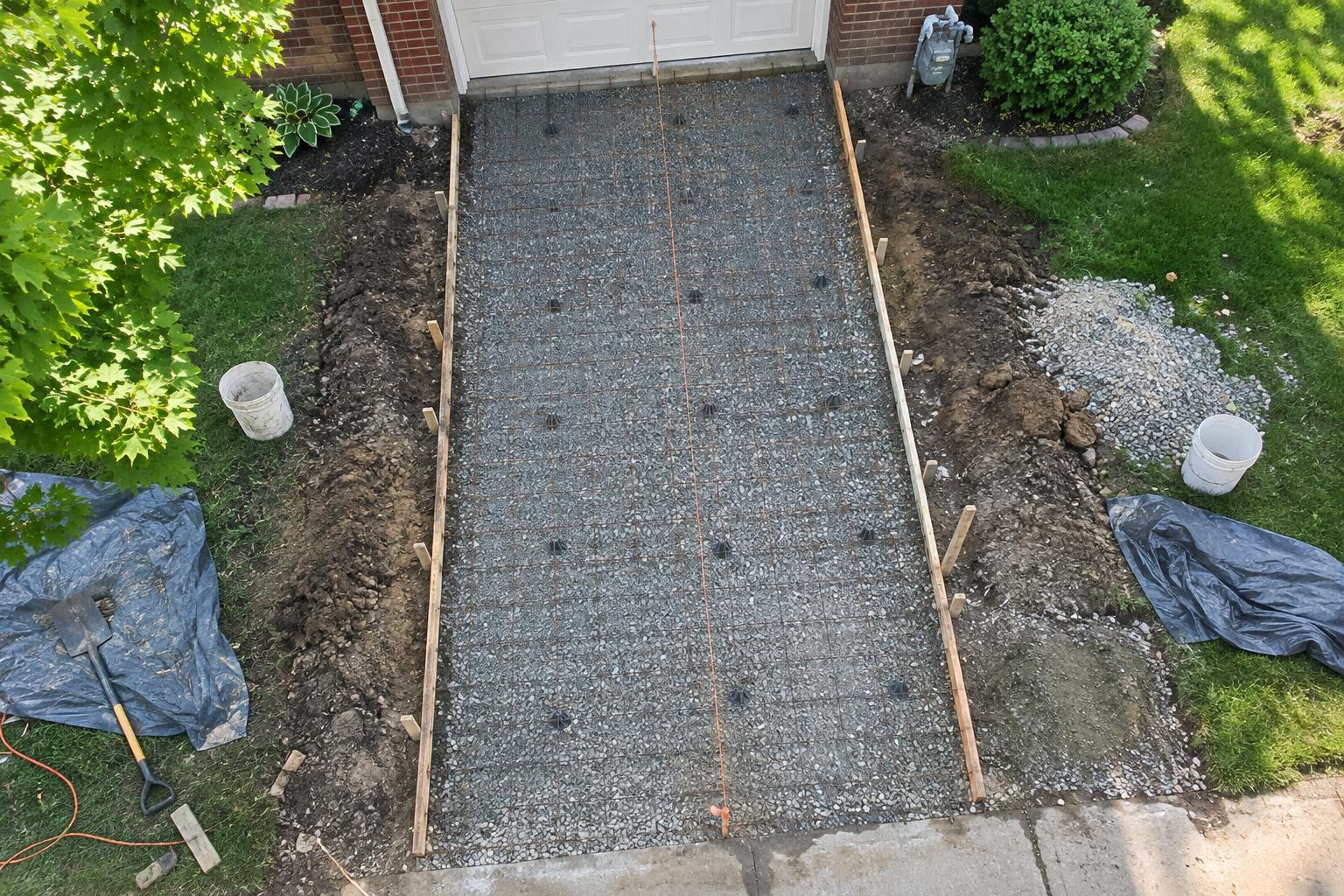
A proper driveway installation in Dearborn Heights starts with removing the old concrete completely and hauling it away. Once the slabs are out, the crew looks at what was underneath. Soft, organic or pumping soil gets dug out. Tree roots that lifted the old slab get cut back where it is safe for the tree.
Then comes the base. On clay, a compacted layer of crushed stone gives water somewhere to go and gives the slab a firm, even surface to rest on. It goes down in lifts and gets compacted with a plate compactor so it holds its shape. This step decides how the driveway behaves ten winters from now more than anything you see on the surface.
Grading happens here too. Forms get staked along both edges, and a string line sets the pitch so water runs away from the garage and the house toward the street or the lawn. On a lot where the old driveway held a puddle at the garage, correcting that slope is often the biggest improvement a homeowner notices.
Thickness, Reinforcement and Control Joints
Residential driveways that carry cars and the occasional delivery truck are poured thicker than walkways. The approach at the street is often held to a specific thickness by the city. Your estimate should state the planned thickness so you can compare bids fairly.
Reinforcement, such as wire mesh or rebar set on chairs so it sits within the slab, helps hold cracks tight if they form. Concrete shrinks as it cures and moves with temperature, so some cracking is normal. Control joints, either tooled in while wet or saw-cut soon after the pour, give those cracks a straight, planned place to happen. Spacing matters. Joints set too far apart invite random cracks between them.
For winter, ask about an air-entrained mix. Tiny air bubbles in the concrete give freezing water room to expand, which helps the surface resist the scaling that road salt and freeze-thaw cycles cause. Sealing the slab after it cures adds another layer of protection against salty slush dripping off your car.
The Approach, the Permit and the Street
The section of driveway between the sidewalk and the street, usually called the approach, sits in the city right-of-way. In Dearborn Heights, as in most Wayne County communities, work there generally needs a permit and has to meet city standards for thickness, slope and how it meets the curb and public sidewalk. If your driveway crosses the sidewalk, that panel may need to be replaced to city spec at the same time.
Confirm the details with the city building department early, because inspection timing can affect when the approach gets poured. Your contractor should know the process and build the schedule around it.
Pour Day, Curing and the First Winter
On pour day the ready-mix truck backs up to the forms. The crew places, screeds and floats the concrete, then edges it and applies a broom finish for traction. That texture matters on a sloped driveway when you are walking out to the car on icy mornings.
After that, patience. Foot traffic is usually fine within a day or two, but cars should wait longer, typically about a week, and heavy vehicles longer still. Concrete keeps gaining strength for weeks. Plan the pour so the slab can cure before the first hard freeze and the first salt. During the first winter, use sand for traction and keep rock salt off the new surface.
If you are already rethinking the back of the property, it can make sense to plan a Patio Installation alongside the driveway, since the same clay prep applies in the backyard. Driveway extensions, a wider parking pad or a new walkway to the front door are also easier to tie in while the crew is on site.
Getting a Useful Estimate
A good estimate in Dearborn Heights spells out the tear-out and haul-away, base depth, slab thickness, reinforcement, joint layout, the approach and any sidewalk panels, and who handles the permit. SC Concrete Services provides free estimates for driveway installation and replacement, along with patios, walkways, sidewalks, stamped and decorative concrete, and driveway extensions. Call (734) 720-9815 to have someone walk the driveway with you and talk through what your soil and lot need.