
If your Northville driveway is cracking across the middle, lifting at the apron, or holding puddles after every rain, you are seeing the result of our winters. Water gets into small gaps, freezes, and pushes the slab apart a little more each year. Road salt tracked up from the street does the rest, pitting and flaking the surface until it feels rough underfoot. A well built concrete driveway handles this, but only if the work below the surface is done right the first time.
Here is how a new driveway comes together, and what actually matters in this part of Metro Detroit.
The Ground Under Your Driveway in Northville
Northville sits where the heavy lake-plain clay to the south and east starts giving way to rolling glacial till, with pockets of sandier ground on the higher north and west edges of town. That matters a lot. Clay holds water and swells when it freezes, so a slab sitting on untreated clay tends to heave in winter and settle back in spring. Sandy or gravelly ground drains better but still needs a proper compacted base.
Before we pour anything, we look at what your lot is sitting on. On clay, we dig a little deeper and bring in more aggregate so the slab is riding on a stable, well draining cushion instead of soil that moves with the seasons. The goal is simple. Keep water moving away from the concrete and give it something firm to rest on. You can read more about our full approach to driveway installation in Northville and how we adjust for different soils around town.
Tear-Out and Base Prep
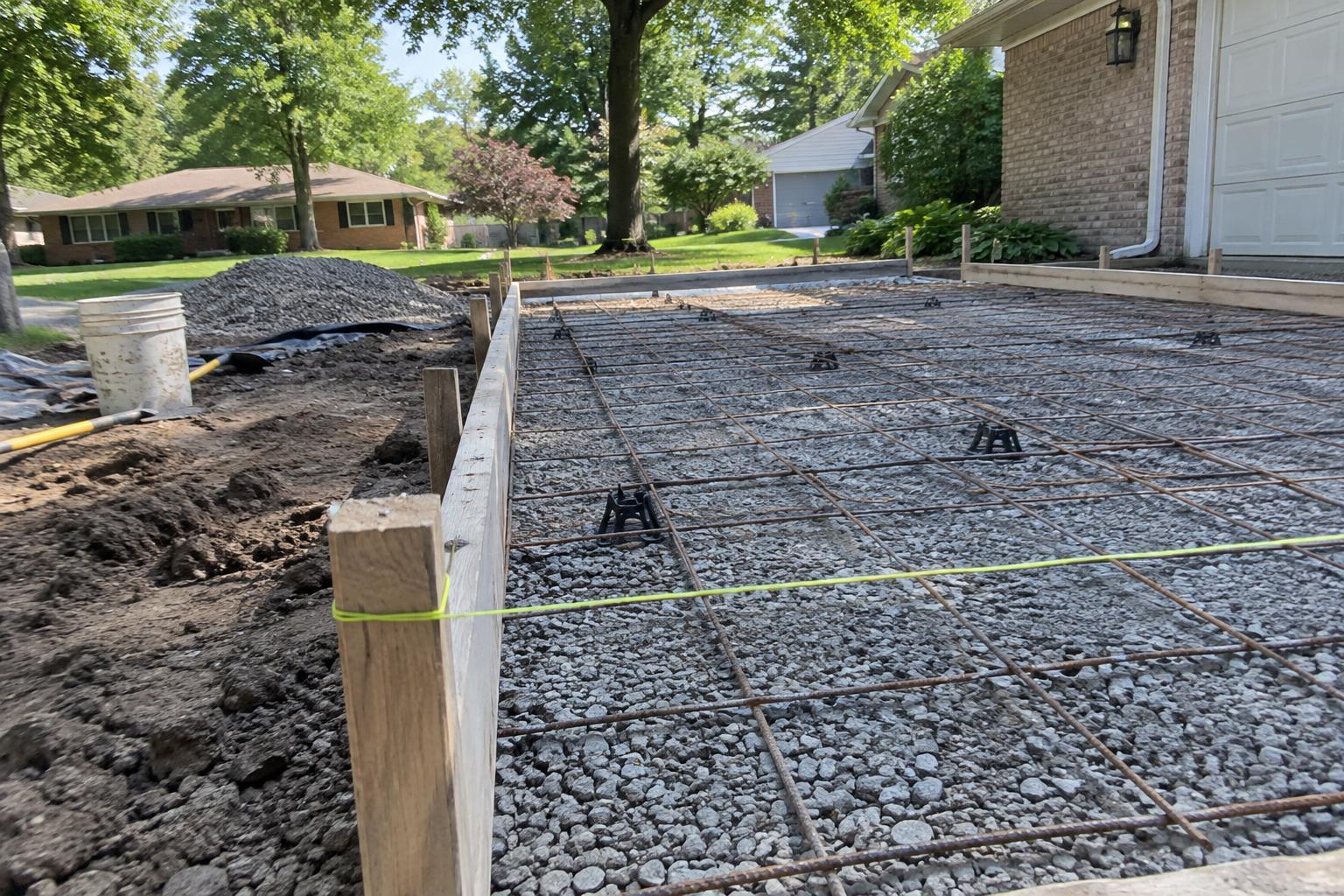
If there is an old driveway in the way, it comes out first. Broken slabs get loaded out, and we check the soil underneath for soft spots or old fill. Then we build the base. We bring in crushed aggregate, grade it to drain away from the house and the garage, and compact it in layers so it does not settle later.
Forms go in next. Straight, staked wood or steel edges hold the shape and set the slope. A good driveway sheds water to the sides or the street, never back toward your foundation. We also plan where the slab meets the garage floor and the city sidewalk so the transitions are smooth and level.
Thickness, Reinforcement and Control Joints
For a residential driveway that will see cars and the occasional heavier vehicle, we pour a slab thick enough to carry that load without flexing. Reinforcement, either steel mesh or rebar set up on chairs, helps hold the concrete together if the ground moves underneath.
Control joints are the part people overlook. Concrete is going to crack as it cures and as the seasons change. Control joints tell it where to crack, in a straight, clean, planned line instead of a jagged break across the middle of your driveway. We cut or tool these at the right spacing for the slab size. In a freeze-thaw climate like Northville's, joints and proper edging do more to keep a driveway looking good over time than almost anything else.
Pour Day, Finish and Curing
On pour day the ready-mix truck backs in and we place the concrete, screed it flat, and float the surface. Most Northville driveways get a broom finish, which gives you grip when the slab is wet or icy. We run clean edges along the lawn and tool the joints while the concrete is still workable.
Then comes curing, which is just giving the concrete time to gain strength. We keep it protected and ask you to stay off it. Foot traffic waits a bit, and vehicles wait longer. Rushing this step is how thin, weak surfaces end up scaling the first winter. A little patience here pays off for years.
Permits, HOA Rules and the City Right-of-Way
Any driveway that connects to a public street involves the approach, the part that sits in the city right-of-way. That usually requires a permit, and the city has standards for how that approach is built. We handle this as part of the job so the work meets local requirements.
If you live in one of the newer Northville subdivisions, your HOA may have rules about driveway width, finish, and whether decorative options are allowed. It is worth checking before we start. If you are thinking about adding a matching Patio Installation in the backyard at the same time, that can be a good moment to plan both so the look stays consistent.
Getting an Estimate
Every lot in Northville is a little different, so the best next step is to have us look at it. We will check your soil and drainage, talk through widths, finishes and any extension you want, and give you a free estimate. Call SC Concrete Services at (734) 720-9815 when you are ready.