
Walk your driveway the morning after the next rain this week and note where water is still sitting by lunchtime. A puddle that lingers tells you the ground under that section has settled or was never graded to drain. In Taylor, that is usually the clay talking.
Most of Taylor sits on the old lake plain that runs across southern Wayne County. The soil is dense, flat and slow to drain. It holds water like a bowl, and when that water freezes in January it expands and pushes up on whatever sits above it. Then it thaws, softens and lets the slab drop back down a little unevenly. Repeat that for enough winters, add road salt tracked in off Telegraph and Eureka, and you get the cracked, tilted, flaking driveways you see on a lot of streets built in the fifties and sixties.
What a Lingering Puddle Actually Means
Low spots almost always start below the concrete. Either the original base was thin, the clay underneath was never compacted, or a downspout has been dumping water at the same corner for decades. You can patch the surface, but the slab will keep moving because the ground keeps moving.
Look for a few related signs while you are out there:
- Cracks that open wider each spring - One slab edge sitting higher than its neighbor, which is a trip hazard and a shovel catcher - Surface flaking or pitting near the garage, where salty slush drips off cars - Gaps opening between the driveway and the garage floor or sidewalk
Two or three of these together usually point toward replacement. That is where full driveway installation makes sense, since it lets the crew fix what is underneath.
How Driveway Installation in Taylor Handles the Clay
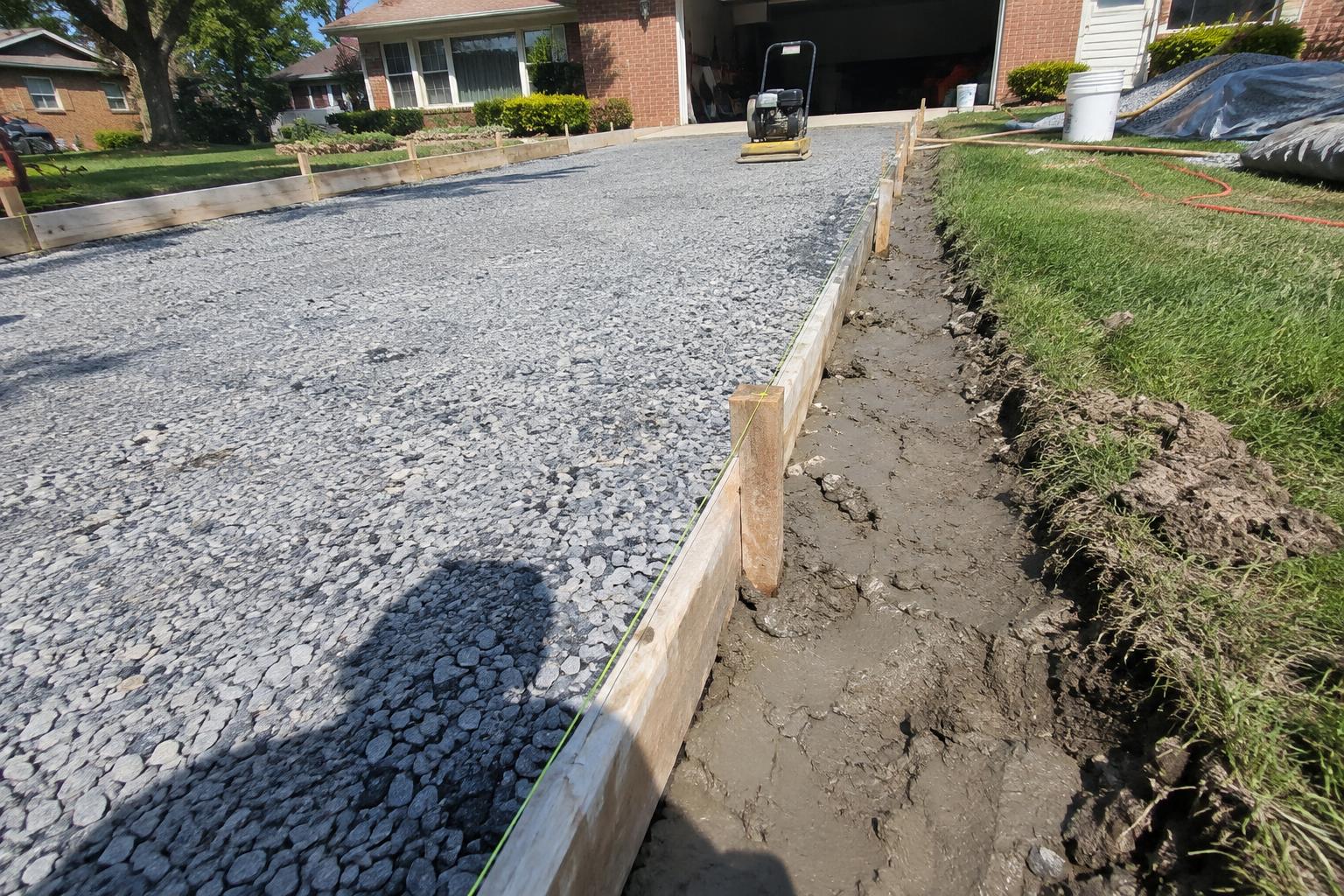
The work starts with tearing out and hauling away the old concrete. Then comes the part homeowners rarely see but should ask about: the subgrade. On Taylor clay, the crew digs out soft or organic soil, shapes the ground so it pitches away from the house, and compacts it. A layer of crushed stone goes on top and gets compacted in lifts with a plate compactor. That base gives water somewhere to go and spreads the load so the clay below is less likely to pump up through cracks.
Slope matters as much as depth. A driveway should shed water toward the street or the lawn and away from the garage door and foundation. On flat lots that takes careful string lines and form setting, since there is very little natural fall to work with.
The concrete itself should be an air-entrained mix. Those tiny trapped air bubbles give freezing water room to expand inside the slab, which is a big part of why a properly mixed driveway resists scaling in a Michigan winter. Forms get staked along the edges, reinforcement goes in where the layout calls for it, and the slab is placed, screeded, floated and edged. You can see how SC Concrete Services approaches each step on our driveway installation in Taylor page.
The Approach, the City Permit and Your HOA
The section between the public sidewalk and the street, often called the approach or apron, sits in the city right-of-way. Replacing it in Taylor typically needs a permit from the city, and the work may be inspected before or after the pour. Expect requirements about thickness, curb cuts and how the approach meets the sidewalk. A contractor who handles the permit paperwork saves you a trip to city hall and keeps the job moving.
Newer subdivisions add another layer. Some HOAs set rules on driveway width, finish, color or whether you can add an extension along the side of the garage. Read your covenants or call the management company before you sign off on a layout. It is much easier to adjust a sketch than to cut out fresh concrete.
Joints, Finish and the First Winter
Control joints are planned cracks. Concrete shrinks as it cures and moves with temperature, so the crew tools or saw-cuts joints at regular spacing to tell it where to crack. Well-placed joints keep cracking tucked into straight, tidy lines across each panel.
A broom finish gives grip on icy mornings, which matters on a sloped Taylor driveway in February. After the pour, the slab needs time to cure before heavy vehicles go on it, and your crew will tell you when it is safe to drive on.
The first winter is the most sensitive. Skip rock salt on new concrete that season, shovel early, and rinse off the salty slush that drips from your car near the garage. A penetrating sealer applied at the right time adds another layer of protection against salt and water.
Planning the Rest of the Yard While the Crew Is There
Replacing the driveway is a good moment to think about the whole front and side of the property. Many Taylor homeowners widen the driveway with an extension for a second car or a trailer, run a new walkway to the front porch, or replace the cracked sidewalk slab at the same time. Doing the work together keeps grades consistent so everything drains in the same direction.
The back of the house often needs attention too. A new slab off the back door works well with the same mix and grading approach, and our Patio Installation page explains how that project comes together. Stamped and decorative finishes are an option for patios and walkways if you want texture or a stone look next to a clean broom-finish driveway.
Getting a Free Estimate
A good estimate starts on site. We look at your drainage, the condition of the old slab, where the downspouts land and what the approach needs for the city. Then you get a clear plan for tear-out, base, layout and finish. Estimates are free. Call SC Concrete Services at (734) 720-9815 to set up a visit and talk through driveway installation for your Taylor home.