
Allen Park sits on flat, heavy lake-plain clay. Over the years that clay swells when it is wet, heaves when it freezes and shrinks in a dry August, and that cycle slowly tips and cracks backyard concrete. Most homes in the city are brick bungalows and ranches from the 1940s and 1950s, and plenty of them still have the original slab behind the kitchen door. After decades of that movement, the pattern is familiar. The slab has settled toward the house, a crack runs out from the corner of the back steps, and water sits against the foundation wall after every storm.
This post walks through how we approach patio installation in Allen Park, from reading the yard to the last saw cut, so you know what a good job looks like before anyone breaks ground.
Why Backyard Slabs Fail on Allen Park Clay
Clay holds water. When the ground under a patio stays wet and then freezes, it expands and pushes the slab up unevenly. In spring it thaws from the top down, the slab sits on soft mud for a while, and the heavy edges sink. Repeat that every winter and the slab ends up tilted, cracked and rocking underfoot.
The flat lots make it worse. Many Allen Park backyards have almost no natural fall, so rain from the roof and the patio itself has nowhere obvious to go. A slab that was poured level, or one that has sunk back toward the house, sends water straight at the basement wall. Downspouts that empty onto the patio add to the problem.
Concrete still works very well here when the base, the slope and the joints are planned for clay from the start.
Planning the Size, Shape and Slope
We start in the yard with a tape measure and a few questions. Where does the back door open? Where will the grill and table go? Is there a gas line, an AC unit or a downspout in the way? How far is the fence, and where is the property line?
A patio for a table and four chairs usually needs more room than people expect once the chairs slide back. We mark the outline with paint or stakes so you can stand on it and decide before anything is dug.
Slope is the part that matters most on flat clay. We set the finished surface to fall away from the house, typically about an eighth to a quarter inch per foot, toward a spot in the yard that can take the water. We look at where downspouts discharge and talk about extending them past the edge of the new slab. Some projects need a permit from the city, and we go over that with you during planning. If you live in a newer development with an association, check its rules on size and finish early.
Tear-Out and Building the Base
If there is an old slab, it comes out first, and the broken concrete is hauled away. Then we dig. The goal is to remove topsoil, roots and soft organic material until we reach firm subgrade. On Allen Park clay that dig usually turns up grey, sticky soil that holds a footprint, which tells you how much water it keeps.
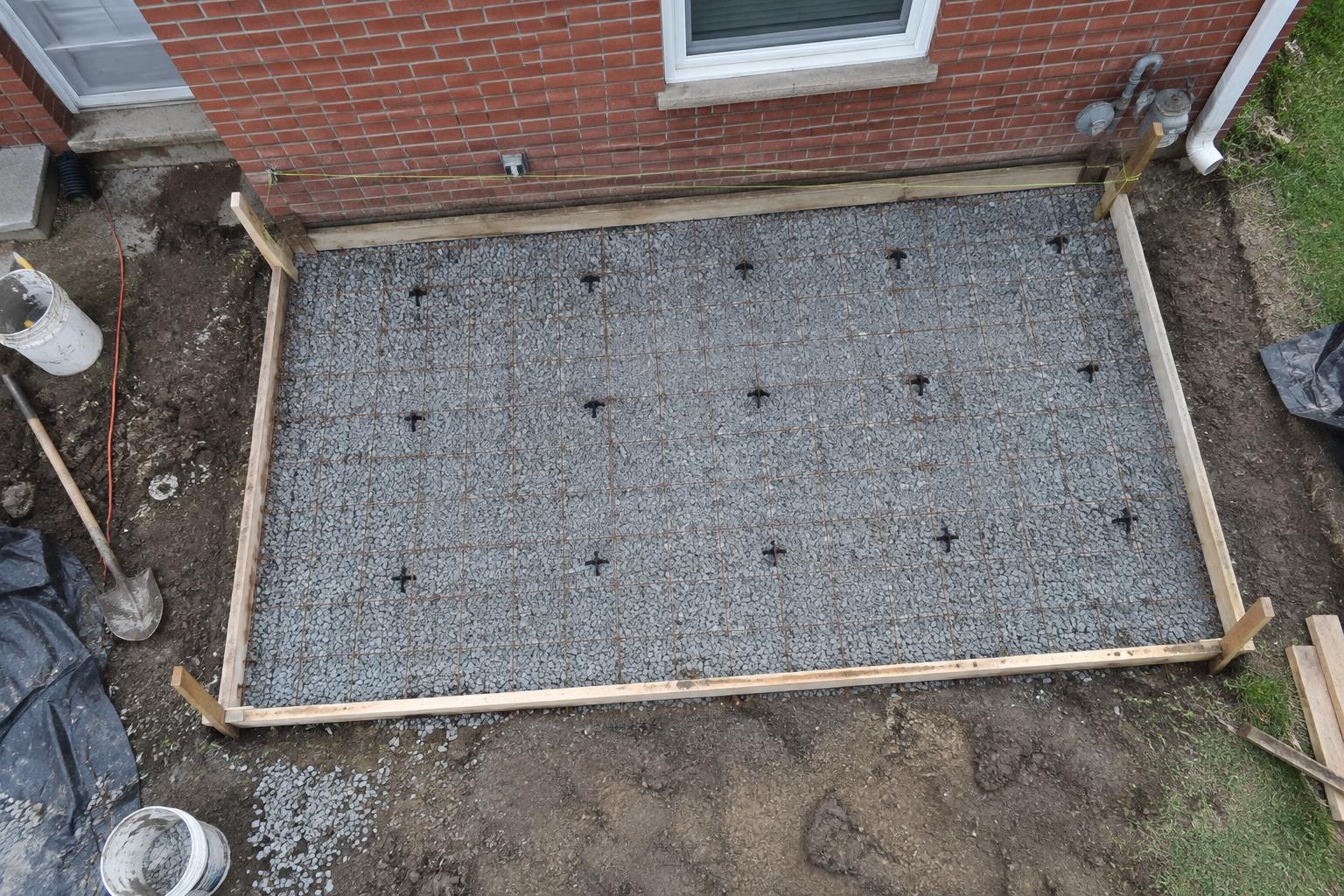
Next comes a compacted base of crushed aggregate, placed and compacted in layers with a plate compactor. A solid, well-drained base gives the slab even support and gives water under it somewhere to move, which cuts down on frost heave.
Then we set forms. Straight lumber is staked along every edge, and a string line is pulled from the house wall out to the far edge to confirm the fall before any concrete arrives. This is the moment to catch a mistake, because once the truck is pouring, the slope is locked in. Reinforcement, either wire mesh or rebar, goes in on chairs so it ends up within the thickness of the slab.
Pour Day, Finishing and Joints
We pour air-entrained concrete, which holds tiny air bubbles that give freezing water room to expand. In Michigan winters that is what keeps the surface from flaking. The concrete is screeded flat to the forms, bull-floated, and edged so the borders are rounded and less likely to chip.
A broom finish is the standard for backyard patios because it gives traction when the slab is wet or frosty. Control joints are tooled into the fresh concrete or saw cut once it has set enough. They give the slab planned places to crack as it shrinks and as the clay moves, so any cracking follows straight, predictable lines.
After finishing, the slab needs time to cure. Keep furniture and grills off until we tell you it is ready, and skip deicing salt on new concrete through its first winter. Sand works for traction. A penetrating sealer applied once the concrete has cured adds protection against water and salt.
Finishes That Suit a Postwar Brick House
Plain broom-finished concrete looks clean next to red or tan brick and is simple to care for. If you want more character, stamped and colored concrete can mimic stone or slate and blend with the house. Stamped patios get a sealer that brings out the color, and that sealer should be renewed every few years.
Many owners tie the patio into a new walkway along the side of the house, so there is one continuous path from the driveway to the back door. If the front of the property needs work too, our Driveway Installation page covers replacements and extensions, which pair well with a patio project. The approach at the street needs a city right-of-way permit, and we help you sort that out.
Getting a Free Estimate
Estimates are free. We come out, measure, look at how the yard drains, check the condition of any existing slab, and talk through size, finish and timing. You get a clear written scope so you know what is included. Call SC Concrete Services at (734) 720-9815 to set up a visit.