
Why late spring is the right window in Dearborn
Late spring is when patio work in Dearborn starts to go well, because the heavy clay under most backyards has finally given up the water from the thaw. In March and early April that soil is saturated. Press a boot into it and the print fills with water. Digging and compacting a base on ground like that traps moisture right where it causes trouble later.
By May and into June the ground firms up, overnight temperatures stay well above freezing, and fresh concrete cures at a steady pace. A patio poured now also gets a full summer and fall to gain strength before its first winter of freeze-thaw cycles. That head start matters here.
Dearborn sits on the old glacial lake plain. Much of the city, from the neighborhoods near the Rouge River out to the west side, has dense clay that holds water and swells when it freezes. Ground that moves every winter is the main reason backyard slabs in this area crack, tilt and lift at the corners.
What goes wrong with patios on Dearborn clay
Walk through enough Dearborn backyards and the same problems show up. A slab behind an older brick bungalow has sunk a couple of inches next to the house, so rain runs toward the foundation. The single step at the back door has pulled away from the patio and now sits higher on one side. A crack runs diagonally from one corner, and weeds fill it by July.
Most of these trace back to what happened before the pour. Many older patios were placed on a thin layer of sand over topsoil, or right on the clay. Topsoil compresses. Clay heaves in winter and shrinks in a dry August. Without a stable, draining base, the concrete rides those movements until it breaks.
Road salt adds to it. Salt tracked in from the driveway or tossed on the patio during an icy week works into the surface and speeds up scaling, where thin flakes pop off the top and leave it rough.
How we build a patio that holds up
Good patio installation in Dearborn is mostly about the work nobody sees once the slab is done. Here is how we approach it.
**Layout and slope.** We mark the patio footprint and set a string line so the finished surface falls away from the house. A gentle pitch, often around an eighth to a quarter inch per foot, moves water off without making the patio feel tilted under a table and chairs.
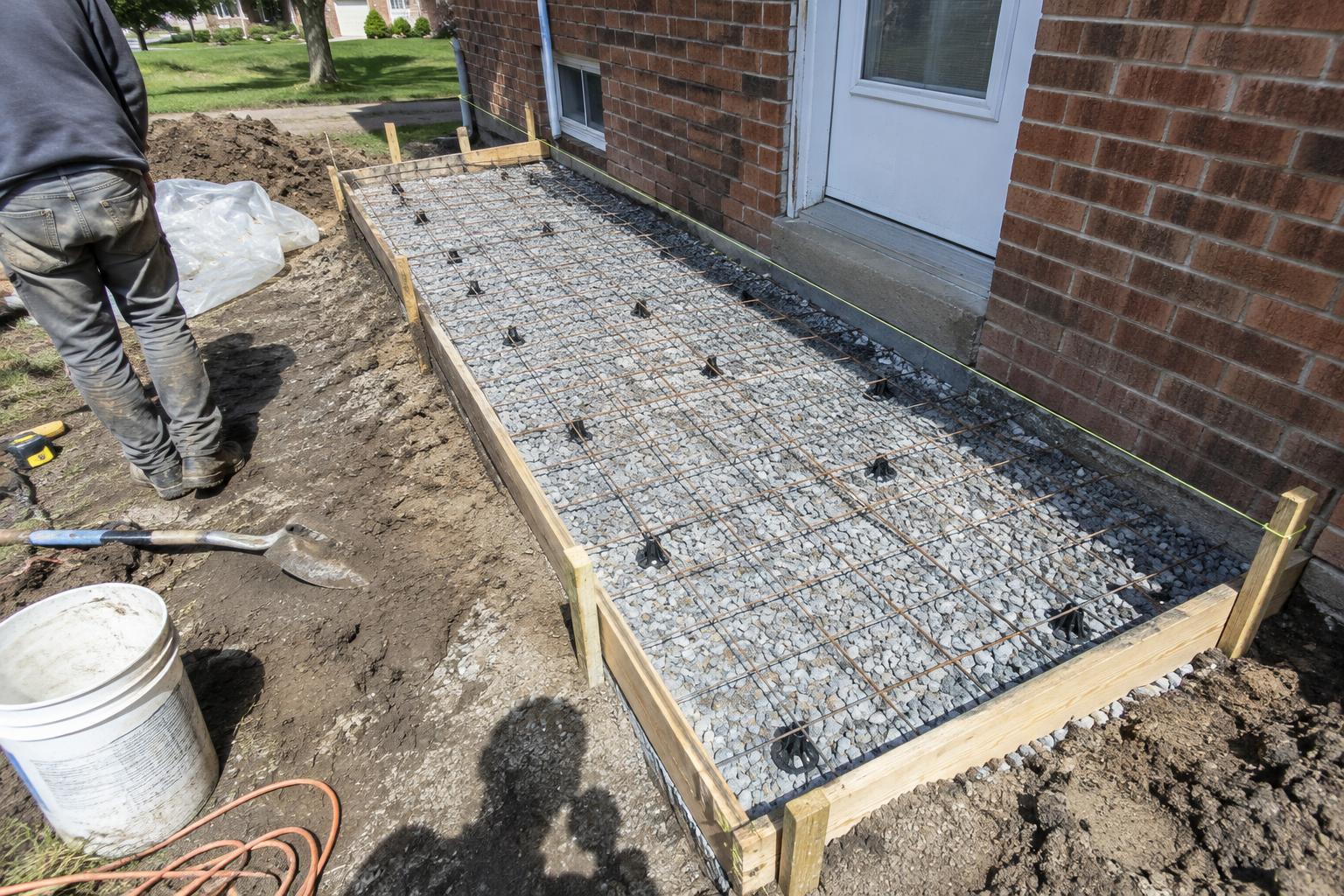
**Excavation.** We dig out the sod, topsoil and soft clay to reach firmer ground. On wet lake-plain soil that sometimes means going deeper than a homeowner expects.
**Base.** Crushed stone goes in and gets compacted in layers with a plate compactor. This gives the slab an even, firm bed and a path for water to drain instead of sitting under the concrete.
**Forms and reinforcement.** Straight forms are staked along the edges. Reinforcement is set on chairs so it ends up inside the slab where it can do its job.
**Pour and finish.** We use an air-entrained mix suited to freeze-thaw climates. The concrete is screeded, floated, edged and given a broom finish for traction, or stamped and colored if you want a decorative look. Control joints are tooled or saw-cut so the slab cracks along straight lines we choose.
**Curing.** Fresh concrete needs moisture and time. We protect the surface early so it gains strength evenly.
Planning around your yard, lot and neighborhood
Dearborn lots are often narrow, with detached garages at the back and tight side yards. Before the job we look at how materials and equipment will reach the backyard. Gate width, fence lines, the garage and any alley access all affect how the pour day runs.
A few other items to sort out early:
- **Utilities.** MISS DIG 811 marks buried lines before digging. Gas, electric and cable often run right through the backyard. - **Permits.** Requirements for patios vary, so it is worth confirming with the City of Dearborn before work begins. We can talk through what applies to your project. - **HOA rules.** Newer subdivisions in the area sometimes have rules on size, color or setbacks. Have those on hand for the estimate. - **Steps and door height.** The patio surface needs to sit at the right height below the back door threshold so the step is comfortable and water stays outside. - **Downspouts.** Gutters that dump onto the patio or against the slab edge will feed the clay underneath. Plan to redirect them.
Many homeowners also look at the front of the house while they are at it. If your driveway is cracked or heaving from the same clay, our Driveway Installation work follows the same base-first approach, and a walkway can tie the two together.
Caring for a new patio through Michigan winters
Stay off the new slab for the first several days, and keep grills, furniture and heavy planters off a bit longer. Use sand for traction during the first winter instead of rock salt, and keep deicers off the patio after that whenever you can. A plastic shovel blade is easier on the surface than steel.
A penetrating sealer applied after the concrete has cured helps resist water and salt. Resealing every few years keeps that protection up. Keep the joints clear of debris and watch where your downspouts drain.
SC Concrete Services builds concrete patios, walkways, sidewalks, driveways and stamped surfaces across Dearborn and nearby communities. Estimates are free. Call (734) 720-9815 to set up a visit and talk through your backyard.