
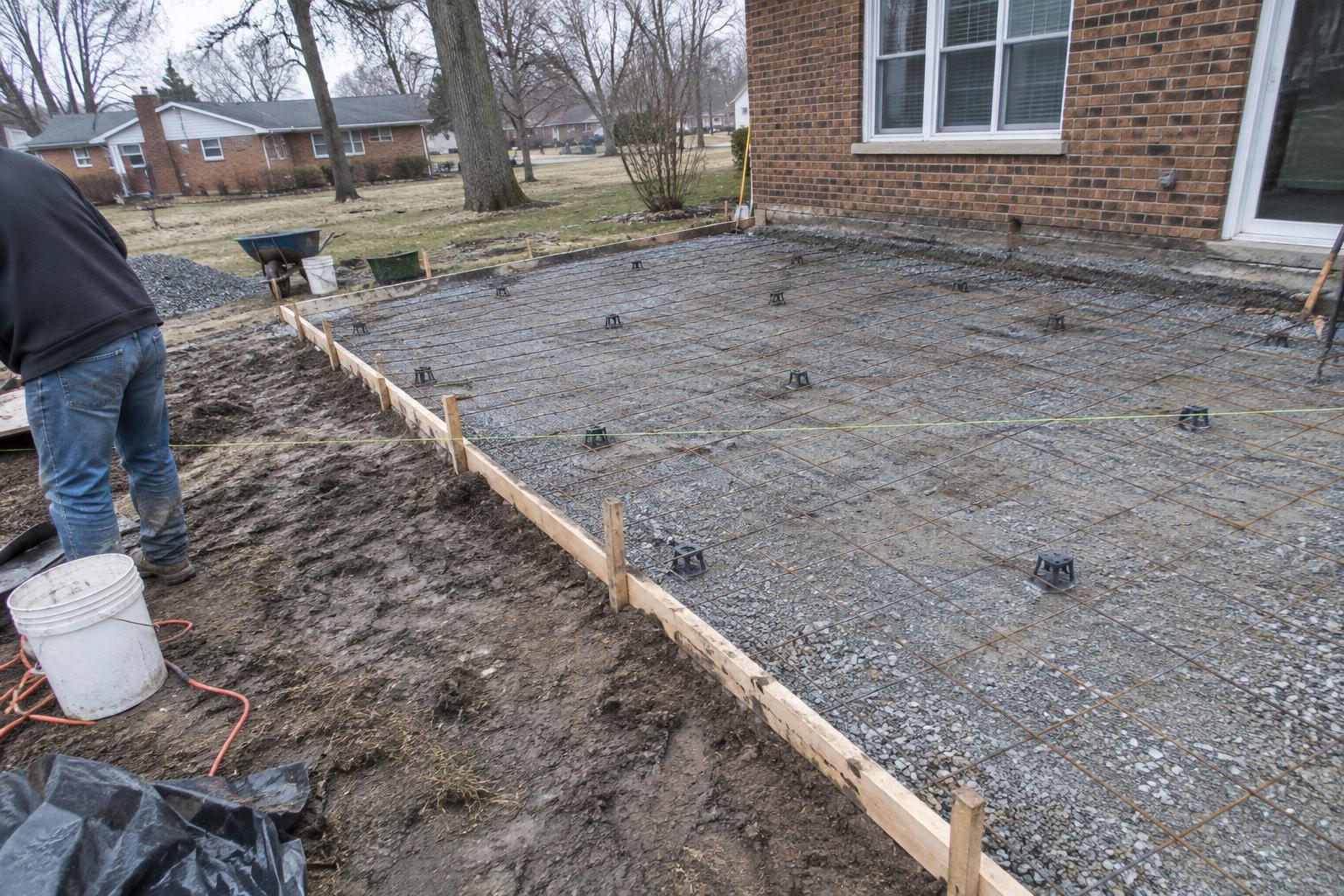
Most backyard patios we look at in Novi sit over a few feet of settled clay fill that was pushed around when the subdivision was graded. That clay holds water, swells in spring, and shrinks in a dry August. On top of that sits our hard freeze-thaw winters. When a slab is poured straight on that ground without a real base, it moves, and movement is what cracks concrete and lifts corners near the back door.
A patio is one of the better projects to get right the first time because you live on it. You set a table out there, kids run across it, and you notice every low spot that puddles after rain. Good patio installation in Novi is mostly about what happens below the surface before any concrete arrives.
What We Find Under Older Novi Patios
Older patios around Novi tend to show a familiar pattern. The slab tilts back toward the house instead of draining away from it. Control joints are missing or spaced too far apart, so random cracks wander through the middle. Along the edges, the surface flakes and pits from years of road salt tracked off shoes and from winter freeze cycles.
Sometimes the problem is simply that the original slab was thin and poured on loose dirt. Clay settles unevenly, one corner drops, and water starts collecting against the foundation wall. Once we see where the low spots and cracks line up, the fix usually points back to base preparation and joint layout.
Getting the Base and Grade Right
The part you never see is the part that decides how long the patio lasts. We excavate down past the loose topsoil and soft clay, then build back up with compacted aggregate. That gravel base spreads the load and gives water somewhere to go instead of sitting under the slab.
Grade matters just as much. The surface needs a gentle slope away from the house so rain and snowmelt drain toward the yard. We set forms and run a string line to hold that pitch across the whole area. On the heavier lake-plain clay to the south and east, we pay extra attention to drainage because that soil holds moisture longer than the sandier ground up toward the north and west.
Reinforcement goes in before the pour. Wire mesh or rebar sits up on chairs so it ends up in the middle of the slab thickness, where it actually helps tie the concrete together and keep cracks tight if the ground shifts.
Pour Day and Finishing
On pour day the ready-mix truck backs as close as the yard allows, and we move concrete by chute or wheelbarrow to the forms. We screed it level to the forms, bull-float the surface, then edge and tool the joints. Those control joints are cut at planned spacing so the slab cracks where we want it to, along a clean line, instead of randomly.
For the finish, a broom texture gives grip when the surface is wet, which is worth having on a patio near steps. Some homeowners want stamped and decorative concrete instead, with a stone or wood-plank pattern and color worked into the surface. That is a good fit for a patio because it reads as an outdoor room. Either way, we let the concrete cure before you load it up with furniture.
Permits, HOA Rules and Property Lines
Novi has plenty of newer subdivisions, and many of them run an HOA with rules about where a patio can sit and how big it can be. Setbacks from the rear and side property lines come into play, and some associations want the plan approved before work starts. We are glad to lay out the slab so it fits those requirements.
A patio behind the house usually does not need a city right-of-way permit the way a driveway approach does, since it is not touching the public street. If you are also thinking about a Driveway Installation at the same time, that front-of-house work does involve the city for the approach, and it often makes sense to plan both while equipment is on site.
Picking a Size and Shape That Works
The most common regret we hear is a patio that turned out too small. A table with chairs pulled out needs more room than people expect. A grill station wants its own corner. We walk the yard with you, mark the footprint, and talk through how you actually use the space before anything is poured.
Squared layouts are simple and clean. Gentle curves and a stamped border can soften the look against a planted yard. We serve Novi and the surrounding western Metro Detroit suburbs, and we tailor each layout to the lot and the soil we find there.